BusinessAbani Sahu11/23/2026
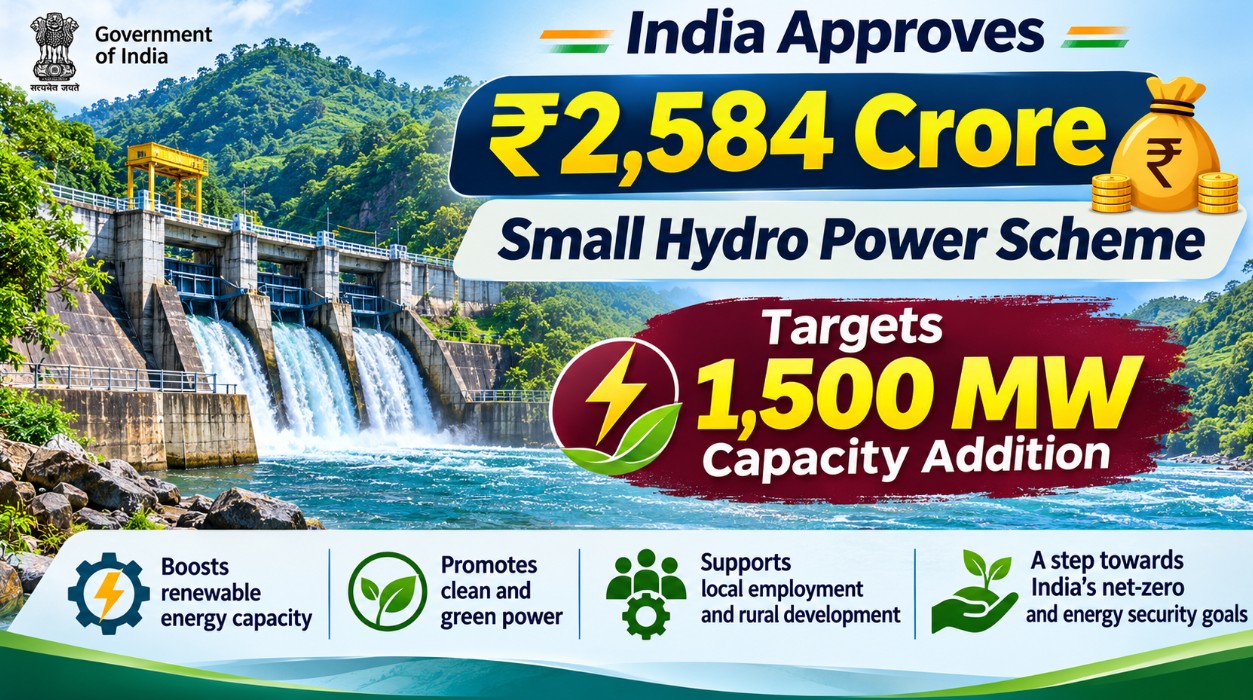
New Delhi, Nov 23: In a major push towards clean energy expansion and energy security, the Government of India has approved a ₹2,584.60-crore Small Hydro Power (SHP) Development Scheme for the financial years 2026-27 to 2030-31, targeting the addition of approximately 1,500 MW of renewable power capacity across the country.
Representational Image
The initiative aims to unlock India's vast untapped small hydropower resources, with particular emphasis on hilly regions, northeastern states and areas along international borders. The scheme is expected to attract investments worth nearly ₹15,000 crore and create significant employment opportunities in rural and remote areas.
India has an identified small hydropower potential of 21,134 MW across 7,133 locations. However, only around 5,182 MW, or nearly 25 per cent of this potential, had been harnessed as of September 30, 2026. The remaining 15,952 MW offers considerable scope for future development.
The Eastern region, including Odisha, has considerable opportunities for small hydropower development. The region accounts for an estimated potential of 1,707 MW, with Bihar leading at 527 MW, followed by West Bengal at 392 MW, Odisha at 286 MW, Sikkim at 267 MW and Jharkhand at 228 MW.
The development of small hydro projects in Odisha could support decentralised electricity generation, particularly in rural and underserved areas. Better utilisation of local water resources could also strengthen agricultural activities, create employment and support regional economic development.
The Ministry of New and Renewable Energy (MNRE), the nodal ministry for small hydropower development, has introduced targeted financial assistance to improve project viability and attract greater investment.
Under the scheme, northeastern states and districts along international borders will be eligible for financial assistance of up to ₹3.6 crore per MW or 30 per cent of the project cost, whichever is lower, subject to a maximum of ₹30 crore per project.
For other locations, assistance will range from ₹1.78 crore to ₹2.4 crore per MW, depending on project size and location, or 20 per cent of the project cost, whichever is lower. The maximum assistance in these areas will be capped at ₹20 crore per project.
The scheme also provides ₹30 crore for preparing Detailed Project Reports (DPRs) for at least 200 projects, helping central and state agencies build a stronger pipeline of future hydropower projects.
Beyond renewable energy generation, the programme is expected to deliver substantial economic benefits. It is projected to generate approximately 51 lakh person-days of employment during the construction phase, apart from creating long-term jobs in project operation and maintenance.
The initiative will also encourage the use of domestically manufactured equipment and machinery, strengthening local industries, supply chains and the government's Atmanirbhar Bharat vision.
Small hydropower projects are those with an installed capacity of up to 25 MW and are particularly suitable for locations where large power projects are difficult to establish.
Unlike conventional large hydropower projects, small hydro installations generally require less land and involve relatively limited displacement. They can utilise the natural flow of rivers, streams and canals to generate electricity without significant fuel requirements.
Their ability to provide reliable, round-the-clock electricity makes them an important complement to solar and wind power, which depend on weather conditions. Projects located close to consumption centres can also reduce transmission losses and improve electricity supply in remote areas.
India's small hydropower resources are spread across five major regions:
Northern Region: 8,030 MW, with Himachal Pradesh, Uttarakhand and Jammu and Kashmir among the major contributors.
Southern Region: 5,490 MW, led by Karnataka with 3,726 MW, followed by Kerala and Tamil Nadu.
North-Eastern Region: 2,995 MW, with Arunachal Pradesh alone accounting for 2,065 MW.
Western Region: 2,912 MW, with significant potential in Chhattisgarh, Madhya Pradesh and Maharashtra.
Eastern Region: 1,707 MW, offering opportunities for Odisha, Bihar, West Bengal, Jharkhand and Sikkim.
The regional distribution highlights the importance of a location-specific approach, with particular attention to infrastructure development and investment in geographically challenging areas.
The Small Hydro Power Development Scheme for 2026-31 is expected to strengthen India's renewable energy infrastructure while addressing the challenge of electricity access in remote locations.
By combining financial incentives, project preparation support, indigenous manufacturing and employment generation, the initiative seeks to turn untapped water resources into a reliable source of clean electricity.
For Odisha and other eastern states, the scheme offers an opportunity to explore their hydropower potential and contribute more actively to India's long-term energy security and sustainable development goals.